
The Unilever McCormick deal is one of the biggest deals in years—but its significance goes beyond the $65 billion headline.
Unilever is merging its food business with McCormick & Company in a move that is reshaping both companies in very different ways. Unilever walked away with $15.7 billion in cash and a substantial economic stake in the joint venture. McCormick, on the other hand, gains scale overnight.
Markets, however, were not convinced. Both Unilever and McCormick’s stock fell after the announcement—suggesting that while the strategy makes sense, the deal itself may be asking investors to accept more uncertainty than they expected.
A deal designed to simplify—on paper
At its core, the experience seems straightforward—even if the mechanics aren’t.
Unilever is splitting its food division and combining it with McCormick using a Reverse Morris Trust, a tax-free structure that allows it to move out of direct ownership without incurring significant tax. When the deal closes, which is expected in mid-2027, Unilever shareholders will own just over half of the combined company, with McCormick shareholders holding the rest. Unilever itself will retain a small stake, which it plans to sell later.
But simplicity is more structural, not economical.
This is not a clean dump. It’s a phased exit—which keeps Unilever open while freeing up cash in the near term, but also leaves investors with a multi-layered ownership structure and an indirect line to the underlying business.
Why Unilever is retreating from food
For decades, food has been part of Unilever’s identity. Brands like Hellmann’s and Knorr’s don’t just make a profit—they’re deeply embedded in global consumer habits.
But they are not where it grows.
In recent years, Unilever’s food division has lagged behind its beauty and personal care businesses. Although margins remain strong, growth has been difficult to sustain. The unit generated more than €10 billion in annual revenue and more than €2.5 billion in operating profit—big numbers, but not enough to change the company’s overall growth trajectory.
That highlights the core issue. The food business is not doing well—it’s growing at a slower rate than the categories that investors value most.
This agreement reflects that change. Underneath Fernando FernandezUnilever has been slowly moving toward a narrower focus on beauty, hygiene, and wellness—areas where demand is high, pricing power is strong, and ratings tend to be high.
In that sense, the decision is less about feeding weakness, and more about redirecting funds where they are expected to generate the highest returns over the next ten years.
A bigger bet for McCormick
If this sounds like a setback for Unilever, it is quite the opposite McCormick & Company.
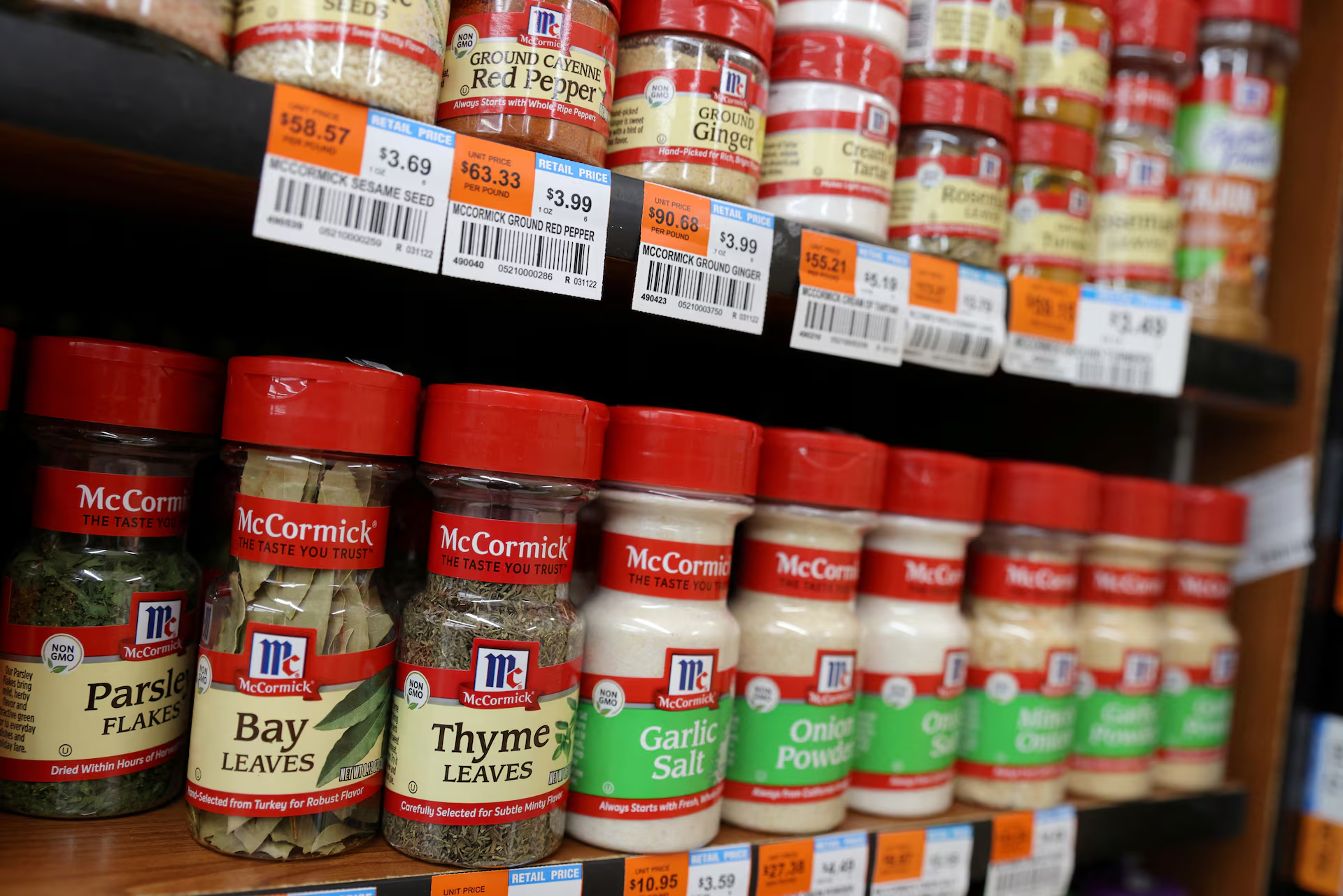
The deal creates a combined business built around some of the most recognizable names in packaged foods. Along its portfolio, McCormick will now include major Unilever food brandsincluding Knorr’s and Hellmann’s, as well as McCormick’s established brands such as French and Cholula.
That brings the combined group to an estimated $20 billion in annual revenue, significantly expanding McCormick’s global reach and deepening its position in cooking, seasoning, and cooking products.
But scale alone is not a prize—it’s what scale allows.
In a segment where growth is modest, size can translate into stronger pricing power, better shelf positioning, and more efficient marketing and distribution. The idea is that a larger portfolio allows McCormick to extract more value from hard-to-grow categories.
At the same time, that makes this a strategy that relies heavily on execution. The combined company will need to deliver integration, cost synergies, and product expansion to ensure the scale it acquires.
In that sense, while Unilever is simplifying its exposure, McCormick is increasing its reliance on manufacturing—making this not just an expansion, but a high bet on its ability to bring growth to a large, complex business.
The tension between the agreement
Despite the strategic sense on both sides, the market reaction points to a more difficult reality.
The core problem for investors is not the strategy itself, but the trade-offs it creates.
Unilever successfully exits a business that generated more than €10 billion a year and a profit of more than €2.5 billion. In return, it receives cash, purchases, and a small amount of complex joint ventures.
That exchange shifts the balance from certainty to power. Instead of full ownership, predictable cash flows, investors are left with indirect exposure and a structure highly dependent on future spending.
In simple terms, Unilever is trading a predictable business for a promise—and markets are rarely comfortable with price promises.
This is where the tension becomes financial. A contract does not eliminate risk—it changes its nature, replacing tangible, recurring earnings with an uncertain form of future value.
For McCormick, the challenge is different but equally important. The combined company is expected to have higher initial strengths, and the success of the deal will depend on the combination—delivering cost savings, consolidating operations, and sustaining growth in a large, complex organization.
Markets are rarely misguided. When both sides fall on a declaration, we often show uncertainty about who gains—and who gives up more.
This is not a question of whether the strategy is working in theory, but whether the amount released today is fully compensated by what is promised tomorrow.
A sign of where the industry is headed
This agreement also reflects a broader change in the food sector.
Packaged food is no longer the reliable growth engine it once was. Private label competition has intensified, consumer preferences are shifting to newer and more health-focused options, and the rise of GLP-1 weight loss drugs has begun to influence what investors think about long-term demand.
But the most important change is how markets value that growth.
In the case where capital growth is directed to the growing, high-quality sectors, food businesses are slow they are shrinking from large consumer groups—even when they remain profitable.
Against that background, companies are rethinking how they are structured.
Some double up on important sections. Others divide or divide into slow-growing categories. What they have in common is moving from the traditional “everything under one roof” model to more focused, value-oriented businesses.
In that sense, this is not just a deal—it’s part of a broader redistribution of funds across the sector.
Unilever’s decision fits perfectly with that trend.
What does this mean in practice
For investors, this is not a pure value unlock and is a repositioning of the exchange.
Unilever is becoming simpler and potentially easier to call, but also more transparent in several categories and more dependent on delivering growth in areas where expectations are already high. The upside depends not only on the strategy, but on whether the markets are willing to reward that change with a higher price.
In essence, investors are asked to trade for profit on an uncertain future growth path.
Because McCormick & Company investors, the opportunity is clear but the execution is very difficult. The company gains scale and product power, but must absorb integration risks, deliver synergies, and manage high debt levels—all while maintaining momentum in low-growth segments.
That makes success less about the deal itself, and more about what happens after it closes.
For consumers, the impact will be gradual. Brands like Hellmann’s and Knorr’s will remain on the shelves, as ownership and strategies change behind the scenes. Any real change will come over time, with pricing, product innovation, and how the combined company chooses to position its brands.
Key tactics
This not just a compilation. Risk redistribution.
Unilever is betting that a narrow, high-growth portfolio will command better valuations. McCormick & Company it is a bet that scale will unlock growth that could not be achieved alone.
Both bets make sense.
But the question is not whether this strategy makes sense—it is investors are asked to hold back a lot sure to reach it.
The deal may finally be successful. But it replaces a straight, fully managed business with a more layered structure, delayed exits, and a heavy reliance on operations.
In that sense, the risk hasn’t disappeared—it’s just moved from the business itself to the way it’s built and delivered.
That is why the reaction has been cautious. Not because the strategy lacks logic—but because the value is now so small, and so dependent on what happens next.