

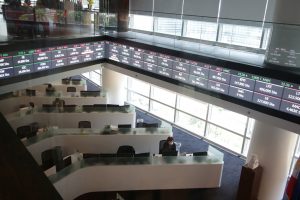
PHILIPPINE SHARES may move sideways as trading resumes after a two-week break as investors weigh country risks and domestic inflation data for March that could show the first impact of the Iran conflict on the economy.
On Wednesday, the Philippine Stock Exchange (PSEi) index rose 0.83% or 49.74 points to close at 5,998.68, while the broader all-stock index rose 0.59% or 19.68 points to end at 3,353.60.
On a weekly basis, the PSEi rose 25.85 points from its March 27 close of 5,972.83.
Philippine stock markets were closed on April 2 and 3 for Holy Week.
“Hopes for a possible end to the Middle East conflict put the gauges in a positive position as sentiment fluctuated in US markets,” 2TradeAsia.com said in a paper.
“The hope that the war in the Middle East will end soon made the local market reach a positive conclusion last week. With this, the bourse was able to achieve its four-week losing streak,” said Philstocks Financial, Inc.’s Research Manager. Japhet Louis O. Tantiangco in a Viber message. “However, 6,000 lines still needed to be closed.”
This week, he said sentiment could remain weak amid continued uncertainty over a war involving the United States, Israel and Iran. “US military threats against Iran that risk escalating the conflict cast doubt on earlier claims that the war would end in two to three weeks.”
On the other hand, encouraging developments in relation to the Strait of Hormuz including: the safe zone of the Philippines across the Strait as granted by Iran; a discussion of about 40 countries on ways to reopen the Strait; and the signing by Iran and Oman of an agreement to monitor traffic in the Strait, may provide relief to the market.
Mr. Tantiangco said investors are expected to also monitor the release of Philippine inflation data for March scheduled for Tuesday (April 7), as this could provide insight into how the Middle East conflict is affecting the economy.
A BusinessWorld a poll of 18 analysts gave an average estimate of 3.8% of the consumer price index for March in March, faster than 2.4% in February and 1.8% last year. This is within the Bangko Sentral ng Pilipinas’ (BSP) forecast of 3.1%-3.9% for the month and 2%-4%.
Mr. Tantiangco said the PSEi’s support is still at 5,800, while resistance is at 6,000.
For its part, 2TradeAsia.com has placed the PSEi’s immediate support at 5,800, resistance at 6,050, and secondary resistance at 6,300.
“At home, the oil crisis continues to bite hard and fast… Headline inflation and BSP policy risks have increased significantly after the shock; we maintain that the central bank’s room is more delayed compared to last year, which makes the stimulus from that fill better,” he said.
“With the destruction of demand from higher pump prices compounding the pressures on store shelves and utilities, this summer season is expected to post weak consumption and output figures since the pandemic.” – Alexandria Grace C. Magno