

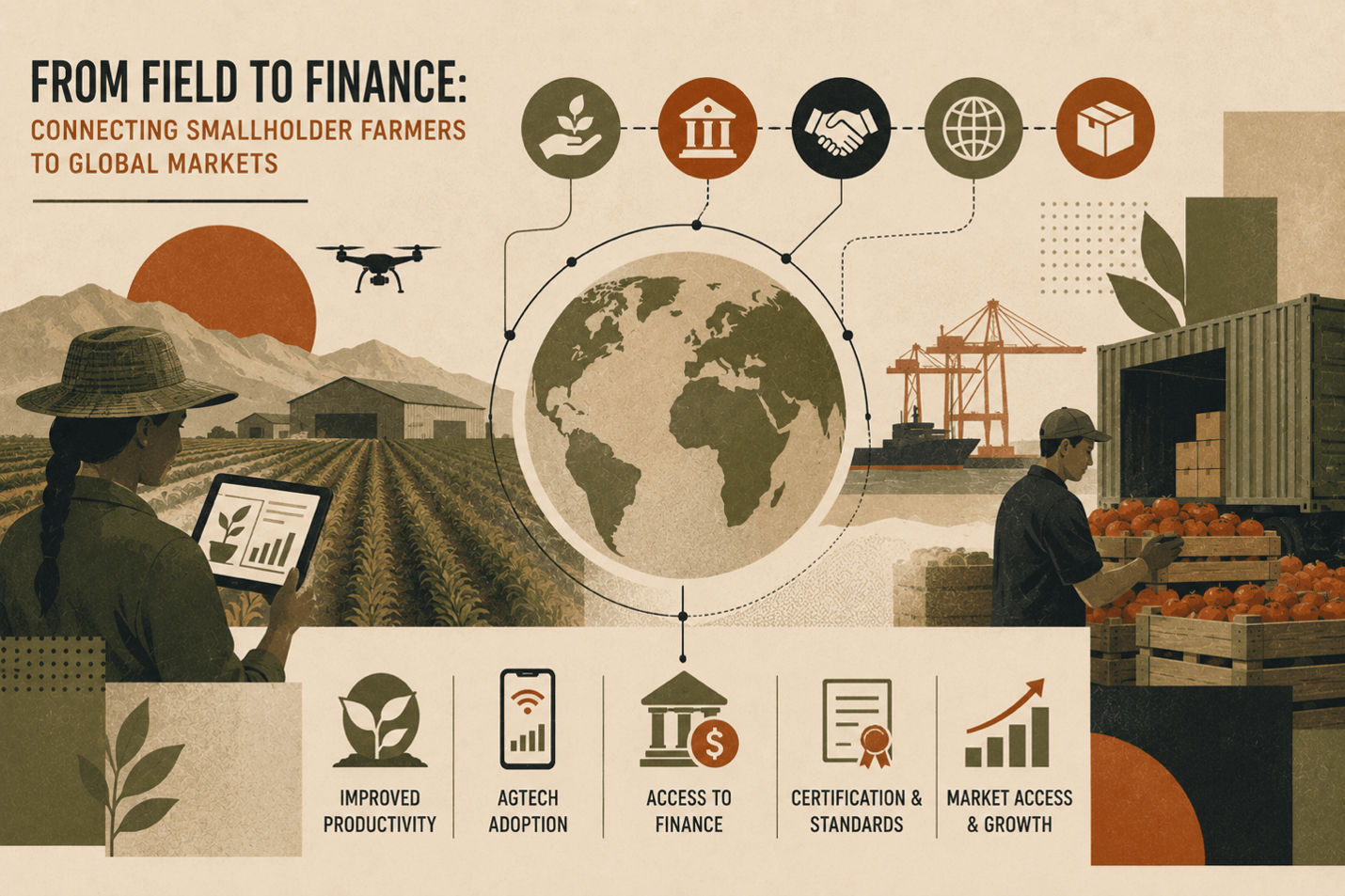
There are an estimated 570 million smallholder farmers who produce more than 70% of the world’s food. Most of them do not have access to financing, certification, or buyer relationships that would allow them to be sold in high-value markets.
That gap is not a productivity problem. Global crop yields per hectare have more than doubled since the 1960s, but many small farmers are still unable to translate that output into high-value sales. The barriers are structural: post-harvest losses are high without cold infrastructure; certification requirements block access to foreign markets; financial institutions rarely offer products in line with seasonal agricultural cash flows; and market knowledge is concentrated among large exporters rather than among small farmers. A farmer producing high-quality fruit in Moldova or specialty crops in Georgia may grow a product that meets high standards without a reliable path to a buyer willing to pay for it.
Market Access Barriers Facing Smallholder Farmers
In all areas, many small farmers face similar obstacles. Financial institutions generally do not offer products suitable for agricultural cycles: yield-based payments, input credit, or seasonal working capital. International market certification (GLOBALG.AP, environmental standards, or food safety) requires investment and technical knowledge that many smallholder operations do not have internally. Market information (what international buyers want, where to find them, what quality premiums exist) is often concentrated among large exporters and unavailable to small producers.
Post-harvest losses make all three difficult. A farmer who is unable to sell the product to the buyer quickly because of poor cold storage or poor road access loses the limit that would have led to the certificate being obtained and should have been followed.
Chemotics’ Strategic Approach to Agribusiness Growth
Chemonic’s work in agribusiness includes five interconnected areas: market access and growth, product development and production, access to finance and investment, AgTech adoption and integration, and sustainability. The work is designed to be the last, because a farmer or an agricultural business based on only one area rarely achieves a different market outcome.
On the financial side, Chemonics designs personalized loan products: yield-based payments, digital microloans, and integrated financial instruments modeled on agricultural cycles. On the technology side, the work includes AI-enabled crop diagnostics, drone field mapping, internet-connected field sensors that monitor soil moisture and plant conditions, and blockchain-enabled supply chain tracking. These tools are used as integrated parts of the business and agricultural support that smallholder farmers already receive, rather than being offered as stand-alone digital products. Partnerships with Cargill and Bayer USA support work on input quality, supply chain standards, and sustainable manufacturing practices.
Connecting Georgia Farmers to Consumers Through AgTech
To modernize Georgia’s agricultural sector, Chemomics has partnered with the Georgian Farmers’ Association and Adjara Group to create Agronavti: a mobile platform that connects farmers with high-value consumers, provides real-time market and agricultural data, and includes local product certification. The platform has addressed the asymmetry of market-specific information that keeps farmers from selling to low-cost channels.
The platform has facilitated $4.6 million in sales, reached over 200,000 users, and introduced AI tools that support smart farm decisions. Direct contact with the buyer changed the price dynamics for participating farmers: with true market intelligence, they were able to negotiate prices rather than accept whatever they were offered.
Modernizing Moldovan Agricultural Enterprises to Access Key Export Markets
Moldova’s agricultural sector was heavily dependent on Russia and other traditional, low-cost markets. That dependency was made more apparent when trade sanctions, COVID-19, and the war in Ukraine hit in quick succession. Moldovan agribusinesses needed to diversify, but access to the EU and other leading areas required certification, productivity improvements, and consumer relations that many firms did not need to thrive.
Chemicals has worked directly with customers and agribusiness partners and producer groups to fill those gaps. The results for all 458 companies: $201.5 million in domestic sales and exports, $44.9 million in new investments raised, and a measurable change in market structure. In 5 years, EU-bound plum exports increased from 20% of the total to 58%, 3,649 companies adopted new technologies, 100 achieved international certification, and 24 laws and regulations were revised to improve the agribusiness environment.
Women and youth were at the heart of the creation of this program. About 3,000 women and more than 3,300 youth received targeted training that opened pathways to agribusiness that they had never had access to before.
Finance as a Basis for Agricultural Business Growth
Market access and certification is an issue, but small farmers often cannot survive without money. Financial institutions in rural and low-income markets face real barriers to serving this population: agricultural income is seasonal, collateral is limited, and the cost of providing small accounts in scattered locations is high. Standard bank products are not equal.
In Colombia, Chemonics worked with banks and financial institutions to redesign products and service models that make agricultural lending sustainable. The program expanded access to finance to more than a million rural clients, nearly half of whom were women, and opened up more than $1.4 billion in financial services. More than 600 bank access points were established in underserved regions and remained operational after the end of project support. Products are designed for the market, not designed for intervention.
The same principle applies to the work of Chemonics for agribusiness around the world: to integrate financial instruments in agricultural cycles, to build institutional capacity in the country rather than working around it, and to treat market access and finance as interrelated issues. Small farmers produce most of the food the world eats. With the surrounding infrastructure in place—finance, transportation, technology, and markets—they are in a good position to capture the full value of what they are growing, and continue to build on it alongside the institutions and partners that help them.