
NEWNow you can listen to Fox News articles!
Feeling lonely may affect older people’s memory – but it may not speed up cognitive decline, according to new research.
Researchers from Colombia, Spain and Sweden analyzed data from more than 10,000 adults aged 65 to 94 in 12 European countries and found that those who reported higher levels of loneliness performed worse on memory tests at the start of the study, according to a study published this month in the journal Aging & Mental Health.
However, over the course of seven years, memory decline occurred at the same rate regardless of how lonely the participants felt.
GRANDPARENTS KEEP THEIR GRANDPARENTS SAFE, NEW RESEARCH FINDS.
“Finding that loneliness significantly affected memory, but not the speed of memory decline over time was a surprising result,” lead author Dr. Luis Carlos Venegas-Sanabria of the School of Medicine and Health Sciences at the Universidad del Rosario said in a statement.
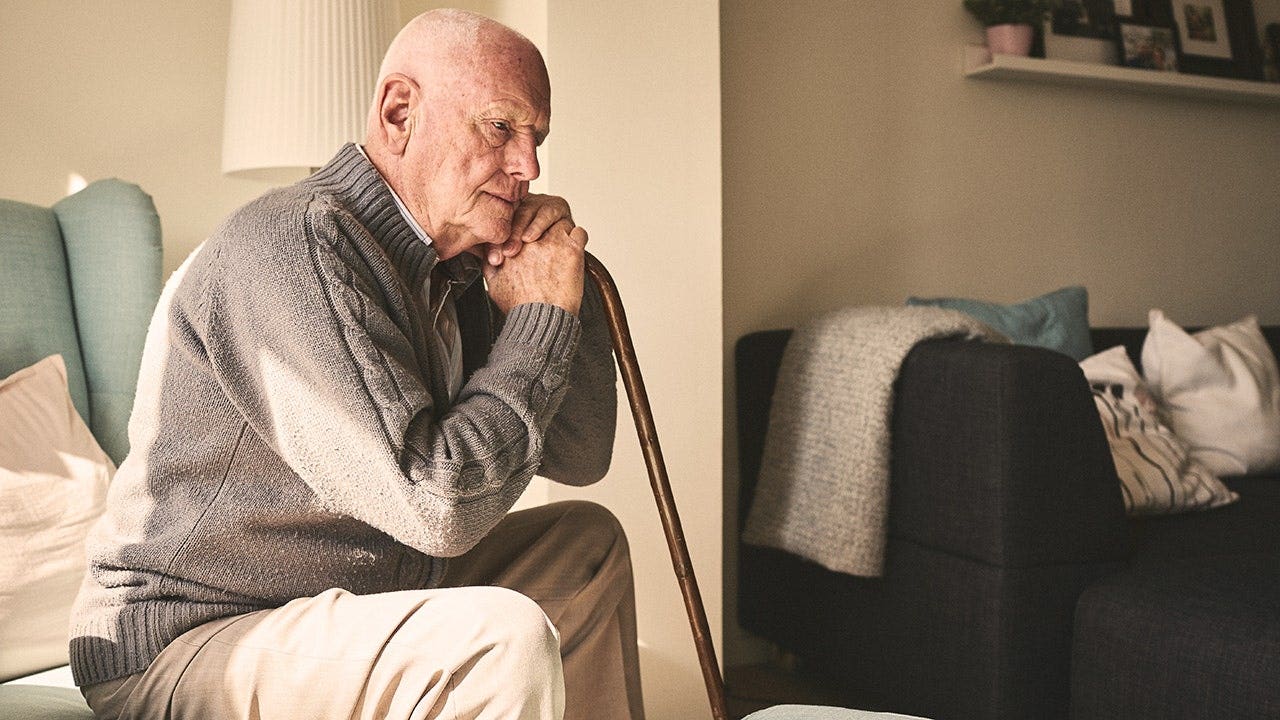
Loneliness may be linked to impaired memory performance in older adults, new research suggests. (Stock)
“It suggests that loneliness may play a more important role in the initial state of memory than in progressive decline,” said Venegas-Sanabria, adding that the findings highlight the importance of coping with loneliness as a factor in cognitive function.
The findings add to the debate about whether loneliness contributes to the risk of dementia. Although loneliness and social isolation are often considered risk factors for cognitive decline, research results have been mixed.
EXPERTS REVEAL HIDDEN LINK BETWEEN POOR SLEEP AND RISK OF ALZHEIMER’S DISEASE
The study looked at data from the Longitudinal Survey of Health, Aging and Retirement in Europe (SHARE), which tracked 10,217 older adults between 2012 and 2019. Participants were asked to recall words immediately and after a delay to measure memory performance.

Social isolation and loneliness can play a dramatic role in mental health among the elderly. (Stock)
Loneliness was assessed using three questions about how often participants felt isolated, left out or friendless.
About 8% of participants reported a high level of loneliness at baseline. That group tended to be older, more likely to be female and have conditions such as depression.
DEMENTIA RISK SIGNS COULD LIE IN SIMPLE BLOOD PRESSURE READINGS, RESEARCHERS SAY.
The researchers found that those with high loneliness had lower scores on both immediate and delayed memory tests at baseline. However, all groups – regardless of level of loneliness – experienced similar declines in memory over time.
The results suggest that loneliness may not directly accelerate the progression of memory loss, although it remains linked to poorer overall cognitive functioning.

Researchers looked at brain scans at the National Institutes of Health in Bethesda, Maryland. (Saul Loeb/AFP/Getty Images)
However, experts caution that the findings should not be interpreted as meaning that loneliness is harmless.
CLICK HERE TO SUBSCRIBE TO OUR LIFE NEWSLETTER
“Finding that lonely adults start out with worse memory but don’t get better quickly is actually the most interesting part of the paper, and I think it’s easy to misread,” said Jordan Weiss, PhD, scientific advisor and aging expert at Assisted Living Magazine and a professor at NYU Grossman School of Medicine.
“It may mean that loneliness is damaging early in life, before people show up in studies like this at age 65 and older,” Weiss told Fox News Digital.

Beautiful elderly Caucasian grandmother using tablet for surfing social media, banking, e-commerce, checking pension, mortgage loan online at home (Stock)
He suggested that by the time a person gets older, long-term social habits may already be established, making it difficult to see when the effects of loneliness start to take hold.
CLICK HERE FOR MORE LIFESTYLES
“By the time you measure someone in their 60s, decades of social interaction patterns have already been incorporated,” he said.
Weiss, who was not involved in the study, added that loneliness may be associated with other health conditions, and noted that participants who felt more isolated also had higher levels of depression, high blood pressure and diabetes. The link, he said, may indicate a clustering of health risks rather than a direct cause.

This bill would cut through “red tape” and allow seniors to share drinks. (Stock)
Amy Morin, a Florida-based psychologist and author, said the findings show a broader pattern in research on loneliness and brain health, and that the relationship may be more complex than it seems.
CLICK HERE TO DOWNLOAD THE FOX NEWS PROGRAM
“The evidence shows that there is a link between loneliness and cognitive decline but there is no direct evidence of cause and effect,” she said. “So even though they can go hand in hand, it’s not clear that loneliness contributes to dementia.”
Morin added that loneliness, which can change, may not be the root of the problem, but a symptom of other mental or physical health problems.

Under current Minnesota law, assisted living facilities face restrictions on serving alcohol during resident events. (Stock)
He said staying socially and mentally connected is important for overall brain health.
TEST YOURSELF WITH OUR LATEST LIFESTYLE QUIZ
“It is important to stand up for things that affect the community,” said Morin. “Joining a book club, having coffee with a friend, or attending faith-based services can be a powerful way to keep in touch with older people.”
The researchers also suggested that loneliness assessment be included in routine psychological evaluations as one way to support healthy aging.
Fox News Digital has reached out to the researchers for comment.