
Low Cost Marketing Ideas For Small Businesses That Get Real Results (Under $50)

📌 THE TRUTH
- Five physical marketing tactics that cost less than $50 each and often exceed what most small business owners spend in the hundreds of dollars each month.
- ROI for direct mail works out to 161% compared to 21% for social media ads, and a postcard costs $0.53 per post.
- After reading this, you will know exactly what to buy, what to write, and who to send it to.
The best inexpensive marketing ideas for small business probably have nothing to do with your phone. While everyone else is scrolling through their ad dashboard and watching their lead costs go up, a postcard is sitting in someone’s kitchen next to their coffee. It has been there for three days. They have read it twice.
I’ve been testing physical marketing strategies with small business owners for years, and the results keep surprising me. A handwritten note closing the sale 14 follow-up emails failed. A branded notebook displayed behind a client video call. A $6 loyalty package that turns a one-time customer into a repeat customer. None of this requires a funnel, content calendar, or social media strategy.
Here are five ideas you can use this week, all for under $50.
1. Postcards — a $50 marketing campaign with a 161% ROI.
A standard 4×6 postcard costs about $0.53 for postage. Print a set of 50 on Canva or Vistaprint for about $25. Your total investment for a 50-person campaign: less than $50.
According to Franklin Madison Direct, direct mail delivers a 161% ROI compared to 21% for social media advertising. Reason is not magic. Mobile mail is intercepted. It doesn’t get buried in the inbox, muted in the feed, or blocked by the spam filter. A postcard lands in someone’s hand.
Keep your message simple: one specific offer, one phone number or URL, and a deadline. There is no novel. There are no five bullet points. Treat it like a text message your best customer would want to receive.
If you travel a lot, buy postcards in your hometown and send them to a client or two. No one sends postcards anymore! No one gets the real email. So if you want to stand out and build a close relationship with customers – this is gold.
Want to go deeper? Read Is Direct Mail Right for Small Businesses? for a complete breakdown of costs per receivable.
2. A handwritten note — the oldest trick in the book for a reason
A pack of 25 note cards at Target: $8. A 10-minute investment by writing five of them: precious (yes, I said it).
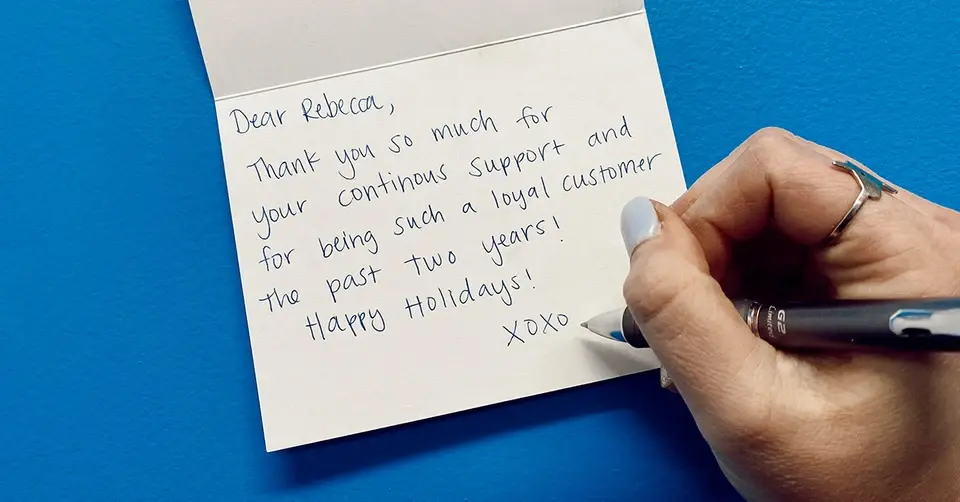
Handwritten notes come in a different form now than ever before. With AI flooding every inbox and every feed, something written by a human feels remarkable like it hasn’t since, maybe, 1995. The Forbes Business Council noted in 2025 that authentic human communication is now “the last trusted space” in the world of AI. A handwritten card is proof that you are a thoughtful person.
Post five a week. One for a new client, one for a long-time client, one for a referral source, one for someone you met at a networking event, and one for a potential cold prospect. Track who is responding. The results will change you forever.
💡 STRATEGIC ALERT
Write notes immediately after a customer contact, before you forget personal details. “I loved hearing about your daughter’s soccer team” beats “Thank you for your business” every time.
I want to throw in another thought here – there are services out there that create “handwritten” notes that you can send in bulk or on demand. THIS IS NOT WHAT I’M TALKING ABOUT.
Don’t cut your way through this. The whole point is to be human, write it with your little hands, heck, even if you make a mistake, get it out and move on. The whole point is to do it yourself.
3. Branded notebook — marketing materials people keep throughout the year
A pack of 10 logo notebooks from VistaPrint runs about $40 to $50. That’s $4 to $5 per item. Contrast that with the branded tote bag that sits on someone’s trunk, never seen by anyone, versus the notebook that sits on their desk for every video call.
Give it to every new client at their first meeting or after their first purchase. Insert a handwritten note inside the front cover. The notebook puts your stamp on every meeting they attend for the next six to twelve months, long after your Instagram post has disappeared from anyone’s feed.
CNBC reported in 2026 that analog, tactile products are driving real business growth as consumers lean toward screens. The notebook is a gift and a statement: you are a business that values real work over digital noise.
4. Thank you package – a $15 move that creates a referral
Here’s the math: a $15 thank you package sent to a customer who spends $500 a year with you is worth 3% of their annual value. If it prevents them from leaving, or triggers one referral, the payoff is amazing.
Keep it simple: a handwritten note, a small item with a name (sticker, pen, magnet), and a $5 Starbucks gift card. Put it in padded mail and send it. Total cost: $12 to $18.
Send this to your top 20% of customers after their first purchase, after a milestone, or after a positive interaction. The surprise factor alone does the job. Many businesses send thank you emails. Shipping a portable package sets you apart from all your competitors in the drip sequence.
To find out more about keeping customers in your corner, read Customer Loyalty: How to Keep Customers Returning and Referral and Loyalty Programs for Small Businesses.
5. Pop-up partnerships — low-cost marketing ideas that touch someone else’s audience
This costs almost nothing. Find a complementary business with similar clients (an accountant and a corporate lawyer, a personal trainer and a nutritionist, a florist and a wedding photographer) and propose a simple exchange.
You tell your customers. They talk about you in theirs. Split the cost of a small event, gift basket, or joint mailing. Each of you reaches a new audience with a trusted introduction.
A pop-up table on its own, a shared workshop, or an integrated “customer awareness” event can generate leads that no ad campaign can match. Interested in an event angle? Read How to Host a Client Appreciation Event That Gets You Business for the full playbook.
⚠️ CHECK THE TRUTH
A pop-up partnership only works if the other business’s customers look like your ideal customers. Spend 10 minutes researching their audience before you propose an exchange. Bad partnerships waste everyone’s time and money.
Frequently asked questions about low-cost marketing ideas for small businesses
What is the cheapest form of marketing for small businesses?
Handwritten notes and pop-up engagements are close at low cost. A pack of note cards runs under $10 and exchanging partnerships costs nothing but time. Direct mail cards are the cheapest paid option, averaging $0.53 per piece of postage. All five strategies on this list cost less than $50 per campaign.
Will postcards still work for small business marketing in 2026?
Yes. The ROI of direct mail averages 161% compared to 21% for social media ads, according to Franklin Madison Direct. Mobile mail is one of the few marketing channels that has worked very well as digital channels become more crowded and less trusted. People are holding postcards. They don’t swipe past them.
How do I measure the ROI of a thank you package campaign?
Track the customers you sent packages to in your CRM or a simple spreadsheet. Compare their repeat purchase rate and referral rate to customers who didn’t receive it in the next 90 days. Even one additional purchase or referral from a $15 package represents a significant return on investment.
What should I include in a small business thank you package?
Keep it simple and personal: a handwritten note that mentions something specific about the customer, one small item with a name (sticker, magnet, or pen), and a small gift card for $5 to $10. A handwritten note does a lot of work. Material reinforces the product. The whole package should feel warm, not advertising.
How do I find the right partner for a pop-up partnership?
Look for a business that serves a similar customer profile but offers a non-competing service. Accountant and business coach, salon and spa, personal trainer and nutritionist: these pairs share an audience but do not compete for the same sales. Start by reaching out to businesses you already know personally. A warm introduction to their audience strikes a cold tone every time. For ideas on how to systematically build these relationships, read How to Ask for a Referral.