

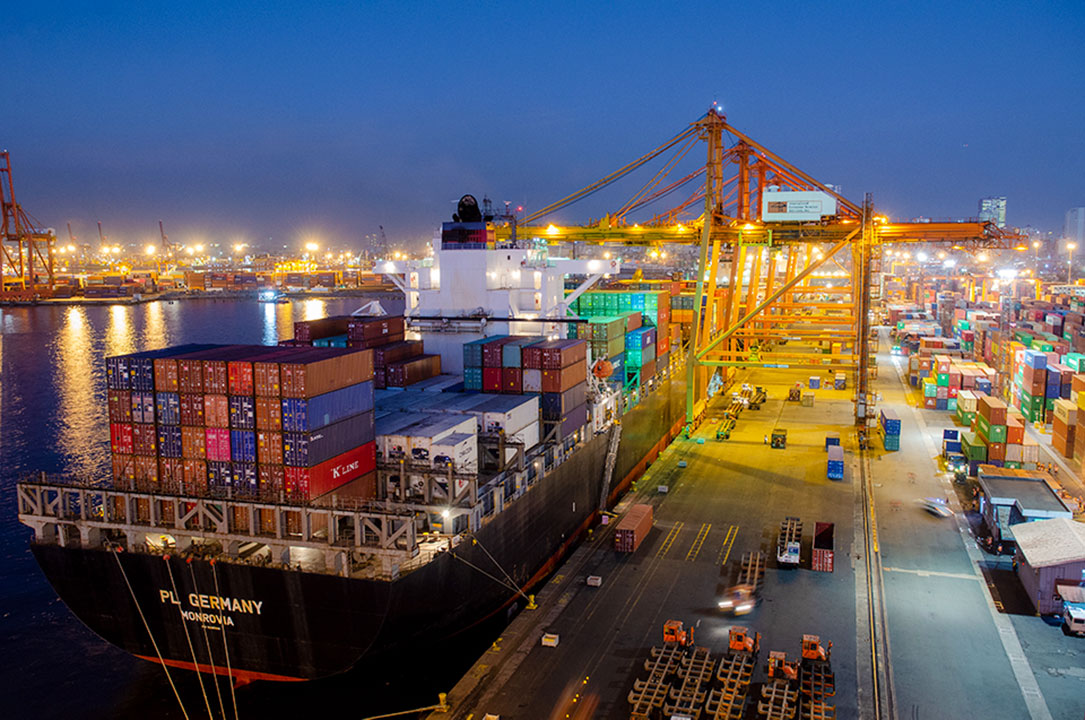
THE country’s goods deficit widened to its largest gap in nearly four years in April, driven by unrest in the Middle East and a weak peso that made imports more expensive.
Preliminary data from the Philippine Statistics Authority (PSA) showed the country’s gross domestic product deficit reached $5.97 billion in April, widening by almost half from the $3.98 billion gap in April last year. The gap also widened from $5.03-billion in March.
It was the largest trade deficit in nearly four years or since the revised $5.99 billion deficit in August 2022.
The country’s trade balance has been in deficit for more than a decade since the $64.95 million surplus recorded in May 2015.
In a research note, Chinabank Research (Chinabank) said the country’s trade performance “continued to show the bloodshed from the Middle East conflict, as rising oil prices increased imports, hampered purchases, and weighed on consumer sentiment.”
However, Chinabank noted that a possible US-Iran truce, which may lower oil prices, and weak domestic demand that reduces imports, could narrow the trade gap later this year.
In April, US President Donald J. Trump began the month saying his troops would withdraw from Iran “immediately,” as he discussed a timeline for an end to the conflict, Reuters reported.
Two weeks into April, Iran tightened control of the Strait of Hormuz – reversing its position on reopening the trade-focused waterway a day earlier – citing the US import ban as a violation of the ceasefire.
Mr. Trump closed the month “unhappy” with the latest progress in negotiations that month, as the proposal sent by Tehran did not go into its nuclear program, which is the main point of the US president.
Cid L. Terosa, a senior economist at the University of Asia and the Pacific, said the increase in imports reflects a weak peso that has increased import costs.
“The weakness of the peso made imports more expensive, undermining any increase in exports due to low prices,” he said in an email.
In April, the peso entered its worst end of the month at P61.567 against the dollar on April 29. The next day it touched a weak intraday record low of P61.75. So far, the local currency’s closest record was P61.75 per dollar on May 19.
Imports rose 22.4% year-on-year in April to $13.17 billion, a change from the 2.4% decline in the same month last year. It was also faster than the 17% expansion in March.
April marked the third consecutive month of growth. It was the largest increase in imports in nearly four years or since the 26.4% increase recorded in August 2022.
On the other hand, total exports of Philippine-made goods grew 6.3% year-on-year in April to $7.21 billion, slower than the 7.6% increase in April 2025 and the 20.8% increase last month.
The value of foreign sales in April was the lowest in three months or from $ 7.14 billion in January.
April saw the weakest export growth in eight months or since the 5.5% gain in August 2025.
In the period from January to April, the trade deficit increased to $19.28 billion from a gap of $16.44 billion in the same period last year.
Exports grew by 11.2% to $29.93 billion in the first four months of 2026, while imports jumped by 13.5% to $49.22 billion.
That month, the country surpassed the 2% growth targets for both imports and exports set by the Development Budget Coordinating Committee (DBCC) for this year.
For Miguel Chanco, emerging Asia economist at Pantheon Macroeconomics, the efficiency of import growth is driven by commodity prices, especially imports, minerals and oil, as well as raw materials and intermediate goods.
“The concern is that this masks a sharp deterioration in ‘real’ demand from other countries, as growth in capital and imports slowed sharply last month,” he said in an email.
PSA data showed that imports of raw materials and intermediate goods during the month jumped by 31.1% to $5.03 billion. This accounted for 38.2% of the country’s total imports in April.
Capital goods grew by 8.2% to $3.68 billion and accounted for 27.9% of the country’s total imports.
Imports of fossil fuels, lubricants and related products jumped 105.6% year-on-year to $2.55 billion.
Mr. Terosa said fossil fuel purchases had a major impact on the import bill that month as “the crisis in the Middle East has pushed up their prices as demand for them increases amid limited supply.”
Meanwhile, imports fell 16.7% to $1.88 billion in April, with Chinabank saying higher fuel costs are strengthening domestic spending, especially on non-essential items.
“With consumption – the main engine of economic growth – still weak, we may continue to see a soft GDP (gross domestic product) print this quarter,” Chinabank said.
In April, China was the leading source of imports with a 29.7% share worth $3.92 billion. It was followed by South Korea with $1.55 billion (11.8% share) and Japan with $4.03 billion (7.3% share).
Electronic products, which accounted for 47.7% of total exports, grew 1.2% year-on-year to $3.44 billion in April.
Semiconductors, which made up the bulk of electronic products and accounted for 33.8% of total exports, fell 4.7% year-on-year to $2.43 billion.
“Semiconductor exports, the country’s largest sector, contracted after 11 months of strong growth, possibly reflecting the impact of earlier reports of order cancellations due to air cargo disruptions caused by rising jet fuel prices,” Chinabank said.
It added that the decline may reflect disruptions in the supply of specialty gases and petrochemical inputs, which have slowed production.
The United States was the top destination for locally made goods in April as the country’s exports reached $1.30 billion, accounting for 18% of all exports.
It was followed by China with $926.66 million (12.9%), Japan $914.64 million (12.7% share), Hong Kong $914.59 million (12.7%) and Singapore $332.75 million (4.6%).
To Mr. However, the comfort in export growth may be due to the underlying effects reversing as exports eased due mainly to weaker demand from Hong Kong despite a relatively strong start to the year.
WATCHING
Sergio Ortiz-Luis, Jr., president of the Philippine Exporters Confederation, Inc., said the country’s trade may remain at a manageable level barring any shock and sudden disruption of the Middle East conflict.
To Mr. Terosa, the remaining months of the second quarter will be a major challenge for the country’s trade as high oil prices, increased import capacity, and increased rates.
He added that in the second half of the year, the country’s trade performance will depend on what happens in the Middle East.
“If the problem ends or is fixed, the second semester could be a turning point. If the problem continues, the second semester will see a trade defense emergency,” said Mr. Terosa.
He warned that meeting the DBCC’s goals of 2% growth in imports and exports by 2026 may be difficult if the dispute continues.
“Government can de-risk imports by using different sources of oil and fuel products and establish foreign financing or foreign exchange de-risking programs for foreign exports and imports,” he said.
He also noted that the country could use global production trends in electric vehicles and batteries by enabling mineral exports.
To Mr. However, import growth will continue to outpace exports due to rising commodity prices, which may put more pressure on the peso’s depreciation.
He said on the other hand exports have lost momentum recently and leading indicators are deteriorating.
“This suggests that this quarter and the next, at least, will be very challenging, given the indirect impact of the war on world trade,” he added. – Matthew Miguel L. Castillo


